
Introduction
The question what is cosmos can be answered by looking at the enormous reality of space and everything that exists within it. The term “cosmos” generally refers to the universe considered as an organized and interconnected whole. It includes galaxies, stars, planets, moons, nebulae, black holes, cosmic radiation, matter, energy, space, and time. While the word is often used in astronomy, it also has a broader meaning in philosophy and everyday language. People have looked at the night sky for thousands of years and wondered how the universe began, what exists beyond Earth, and whether other worlds could support life. Modern astronomy has provided many answers, but the cosmos still contains enormous mysteries. Studying it allows scientists to understand the origins, structure, development, and possible future of the universe while helping humanity place Earth within a much larger cosmic environment.
What Is Cosmos?
To understand what is cosmos, it is useful to begin with the word itself. “Cosmos” comes from an ancient Greek term associated with order, arrangement, and an organized whole. In modern science, cosmos is often used as another way of referring to the universe, particularly when emphasizing its large-scale structure and organization.
The cosmos includes everything known to exist, from tiny particles to enormous galaxy clusters. It includes the space between celestial objects as well as the physical matter and energy found throughout the universe. Scientists study the cosmos through astronomy, astrophysics, cosmology, and related scientific fields. These disciplines investigate questions about the origin, evolution, structure, and behavior of the universe. Although the terms “cosmos” and “universe” are frequently used interchangeably, cosmos can sometimes carry a stronger sense of an interconnected and structured whole.
Cosmos and the Universe
One of the easiest ways to understand what is cosmos is to connect it with the idea of the universe. The universe contains all known space, time, matter, and energy. Everything from Earth and the Solar System to distant galaxies belongs to this enormous system.
The cosmos is not simply an empty region surrounding Earth. Space contains stars, planets, galaxies, gas, dust, radiation, and many other phenomena. Gravity influences the movement and organization of celestial objects, while physical laws govern processes occurring across immense distances. Scientists use observations and mathematical models to understand how these systems formed and how they continue to change. Because the universe is constantly evolving, our understanding of the cosmos also develops as new observations and technologies become available.
Galaxies in the Cosmos
Galaxies are among the most important structures in the cosmos. A galaxy is a vast system containing stars, planets, gas, dust, and other material held together largely by gravity. Galaxies can have different shapes and sizes, including spiral, elliptical, and irregular forms.
The Milky Way is the galaxy that contains our Solar System. It contains enormous numbers of stars and extends across a vast region of space. Beyond the Milky Way are countless other galaxies distributed across the observable universe. Some galaxies exist relatively close to our own on a cosmic scale, while others are billions of light-years away. Studying galaxies allows astronomers to investigate how stars form, how galaxies evolve, how matter is distributed, and how large-scale cosmic structures developed over time.
Stars and Their Importance
Stars are another fundamental component of the cosmos. A star is a massive object composed primarily of extremely hot plasma that produces energy through nuclear processes. Our Sun is an ordinary star compared with many of the enormous stars found throughout the universe, but it is extremely important to life on Earth.
Stars form from clouds of gas and dust under the influence of gravity. Over their lifetimes, they undergo changes depending on their mass and composition. Some eventually become white dwarfs, while massive stars can end their lives through powerful explosions and leave behind neutron stars or black holes. Stars also create and distribute many chemical elements that are important for planets and life. Understanding stellar evolution therefore helps scientists understand not only individual stars but also the broader history of matter in the cosmos.
Planets and Solar Systems
Planets are another major part of the cosmic environment. Our Solar System contains the Sun, eight recognized planets, dwarf planets, moons, asteroids, comets, and other objects. Earth is one of the planets orbiting the Sun and is currently the only known world confirmed to support life.
Astronomers have also discovered thousands of planets outside our Solar System. These are called exoplanets. Some orbit their stars at distances where temperatures could potentially allow liquid water under suitable atmospheric conditions, although being in such a region does not automatically mean a planet supports life. Studying exoplanets helps scientists investigate how planetary systems form and whether environments suitable for life might exist elsewhere in the cosmos.
Nebulae and Cosmic Clouds
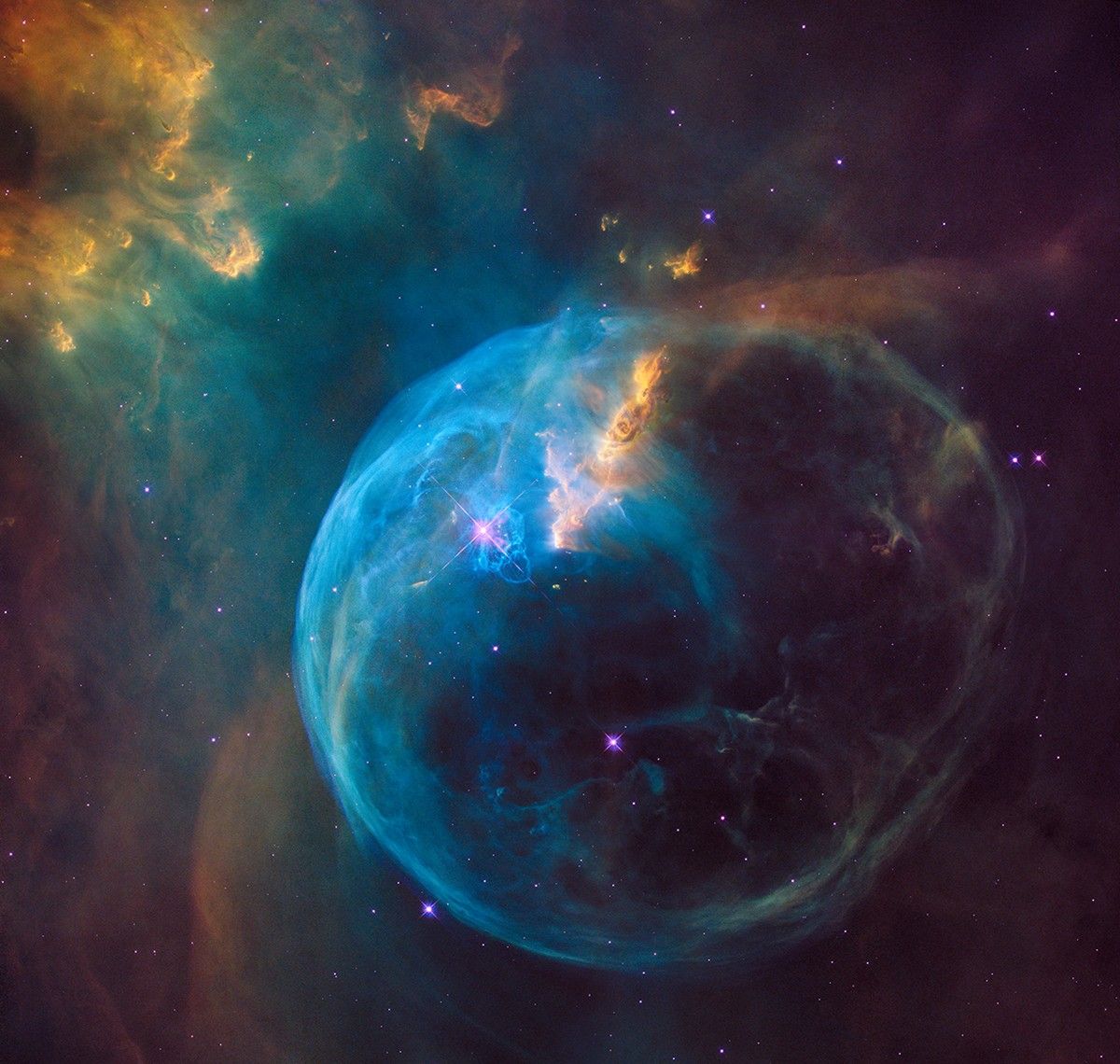
Nebulae are large clouds of gas and dust found in space. Some nebulae are associated with the birth of stars, while others form from material released by dying stars. Their shapes and colors can vary significantly depending on their composition and interaction with nearby radiation.
Nebulae are important because they provide environments where astronomers can observe the processes involved in star formation. Dense regions within certain molecular clouds can collapse under gravity and eventually form new stars. Other nebulae contain material expelled by stellar explosions or the final stages of stellar evolution. These structures demonstrate that the cosmos is dynamic rather than static. Matter is continually moving, changing, forming new structures, and being recycled through cosmic processes.
Black Holes and Extreme Cosmic Objects
Black holes are among the most fascinating objects in the cosmos. They are regions of spacetime where gravity is so strong that, beyond a boundary known as the event horizon, nothing can escape directly, including light.
Black holes can form from the collapse of sufficiently massive stars, while supermassive black holes exist at the centers of many galaxies. Scientists cannot directly observe a black hole in the same way they observe a star, but they can detect its effects on nearby matter, light, and surrounding objects. Observations of gravitational waves and the behavior of material around black holes have provided additional evidence for these extreme objects. Studying black holes helps researchers test theories of gravity and better understand some of the most powerful environments in the cosmos.
The Expansion of the Cosmos
A major scientific discovery about the cosmos is that the universe is expanding. This does not simply mean that galaxies are moving through a fixed empty space; rather, the large-scale fabric of space itself changes over time.
Astronomers discovered that distant galaxies generally show evidence consistent with the expansion of the universe. The farther away many galaxies are, the faster they appear to be receding from us as a result of cosmic expansion. This observation became one of the foundations of modern cosmology. Understanding expansion helps scientists investigate the history of the universe and develop models describing how it evolved from its early state to the enormous structure observed today.
The Big Bang and Cosmic Origins
When asking what is cosmos, another important question naturally follows: how did the universe begin? The leading scientific model is commonly known as the Big Bang model. It describes the universe as having developed from an extremely hot, dense early state approximately 13.8 billion years ago.
The Big Bang should not be imagined simply as an explosion occurring at one location in pre-existing space. Instead, the model describes the early evolution and expansion of space itself. As the universe expanded and cooled, particles formed, atoms developed, and eventually stars and galaxies emerged. Evidence supporting the model includes the expansion of the universe and the cosmic microwave background, which is leftover radiation from the early universe.
Dark Matter and Dark Energy
The cosmos contains phenomena that scientists still do not fully understand. Dark matter is one example. Although it does not appear to interact with light in the same way ordinary matter does, observations of gravitational effects suggest that additional unseen matter contributes to the structure and movement of galaxies and galaxy clusters.
Dark energy is another major mystery. Observations indicate that the expansion of the universe is accelerating, and dark energy is the name commonly given to the unknown component associated with this accelerated expansion. Scientists continue to investigate the nature of both dark matter and dark energy. Together, these mysteries demonstrate how much remains to be discovered about the cosmos despite major advances in modern astronomy.
How Scientists Study the Cosmos
Scientists use many different methods to study the cosmos. Optical telescopes collect visible light, while other instruments detect radio waves, infrared radiation, ultraviolet radiation, X-rays, and gamma rays. Each wavelength can reveal different information about astronomical objects and events.
Space telescopes are particularly valuable because Earth’s atmosphere can block or distort certain forms of radiation. Astronomers also use spacecraft, observatories, spectroscopy, computer simulations, and mathematical models. By combining observations from different instruments, researchers can investigate objects that are extremely distant or difficult to observe directly. Modern astronomy is therefore a combination of observation, physics, mathematics, engineering, and advanced computing.
Why Is the Cosmos Important?
Understanding what is cosmos is important because it helps explain our place in nature. Earth is part of the Solar System, the Solar System is part of the Milky Way, and the Milky Way is one galaxy among an enormous population of galaxies.
Cosmic research has also produced practical benefits. Astronomy has encouraged advances in imaging, sensors, computing, communications, materials science, and other technologies. More broadly, studying the universe helps scientists test fundamental ideas about gravity, matter, energy, time, and space. It also encourages curiosity about questions that extend far beyond everyday experience.
The Search for Life Beyond Earth
One of the most fascinating areas of cosmic research is the search for life beyond Earth. Scientists investigate Mars, icy moons, exoplanets, and other environments that could potentially contain conditions suitable for life.
Finding life elsewhere would have major scientific implications, but researchers must distinguish between environments that could support life and actual evidence of life. So far, Earth remains the only confirmed location where life is known to exist. The search continues through planetary exploration, telescope observations, atmospheric studies, and missions designed to investigate potentially habitable environments.
The Future of Cosmic Exploration
The study of the cosmos is likely to expand significantly as scientific instruments become more powerful. New telescopes can observe more distant objects and examine the early universe in greater detail. Robotic spacecraft can investigate planets, moons, asteroids, and other objects within our Solar System.
Future research may provide better answers about dark matter, dark energy, black holes, galaxy formation, exoplanet atmospheres, and the origins of cosmic structures. Human space exploration may also expand our direct presence beyond Earth. Although many questions remain unanswered, continued research is gradually improving our understanding of the universe and our place within it.
Cosmos and Human Curiosity
Human beings have observed the sky since ancient times. Long before modern telescopes existed, civilizations developed calendars, navigation methods, stories, and scientific ideas based on celestial observations. The desire to understand the stars remains strong today.
The difference is that modern scientists have sophisticated instruments capable of detecting objects and signals that ancient observers could never see. Yet the fundamental curiosity is similar. People continue to ask where the universe came from, how it works, what lies beyond our planet, and whether life exists elsewhere. The cosmos therefore connects ancient curiosity with modern scientific discovery.
Conclusion
Understanding what is cosmos means exploring the enormous and interconnected system commonly described as the universe. It includes galaxies, stars, planets, moons, nebulae, black holes, radiation, matter, energy, space, and time. Modern astronomy and cosmology have revealed that the universe is dynamic, expanding, and far more complex than humanity once imagined.
At the same time, major mysteries remain. Dark matter, dark energy, black holes, the origin of cosmic structures, and the possibility of life beyond Earth continue to attract scientific attention. As technology improves, future observations may answer some of these questions while creating new ones. The study of the cosmos ultimately provides more than knowledge about distant objects; it helps humanity understand the history, structure, and extraordinary scale of the universe in which Earth exists.


