
Introduction
The cosmos is one of the most fascinating subjects humans have ever attempted to understand. The word generally refers to the universe as a whole, including space, time, matter, energy, galaxies, stars, planets, and countless other celestial objects. NASA describes the universe as everything that exists, including all of space and the matter and energy within it. NASA Science Looking into the cosmos allows us to explore questions about where the universe came from, how it developed, what it contains, and what its future might look like. Although modern astronomy has answered many questions, enormous mysteries remain. Scientists continue to study distant galaxies, black holes, dark matter, dark energy, and the earliest stages of cosmic history. The more astronomers observe, the more clearly they understand that the universe is dynamic, enormous, and constantly changing.
What Does Cosmos Mean?
The term cosmos is commonly used as another word for the universe, particularly when the universe is considered as an organized and interconnected whole. The word has roots in ancient Greek, where kosmos was associated with order, arrangement, and the world. Dictionary.com In modern science, the concept encompasses everything from tiny particles and individual stars to enormous galaxy clusters and large-scale structures. The universe contains systems that operate according to physical laws, allowing scientists to study their movements, origins, compositions, and interactions.
Understanding the cosmos requires knowledge from several scientific disciplines. Astronomy examines celestial objects and phenomena, while astrophysics investigates their physical properties and behavior. Cosmology focuses more broadly on the origin, development, structure, history, and future of the universe. The Department of Energy’s Energy.gov Together, these fields help researchers build a more complete picture of the universe and our place within it.
The Origin and Early History of the Cosmos
According to the prevailing scientific model, the universe began developing from an extremely hot and dense early state approximately 13.8 billion years ago. NASA’s cosmic history describes an early period of rapid expansion called cosmic inflation, followed by the formation of matter and light and the processes that eventually produced the first elements. NASA Science This history is often discussed through the Big Bang model, although the phrase can sometimes create the misleading impression of an ordinary explosion occurring inside pre-existing empty space.
As the universe expanded, it gradually cooled. During the first few minutes, conditions allowed the formation of simple atomic nuclei, mainly hydrogen and helium, along with small amounts of other light elements. Hundreds of thousands of years later, atoms could form, allowing light to travel more freely. This ancient light is now observed as the cosmic microwave background, one of the most important pieces of evidence available for studying the early universe. NASA Science
Galaxies Across the Cosmos
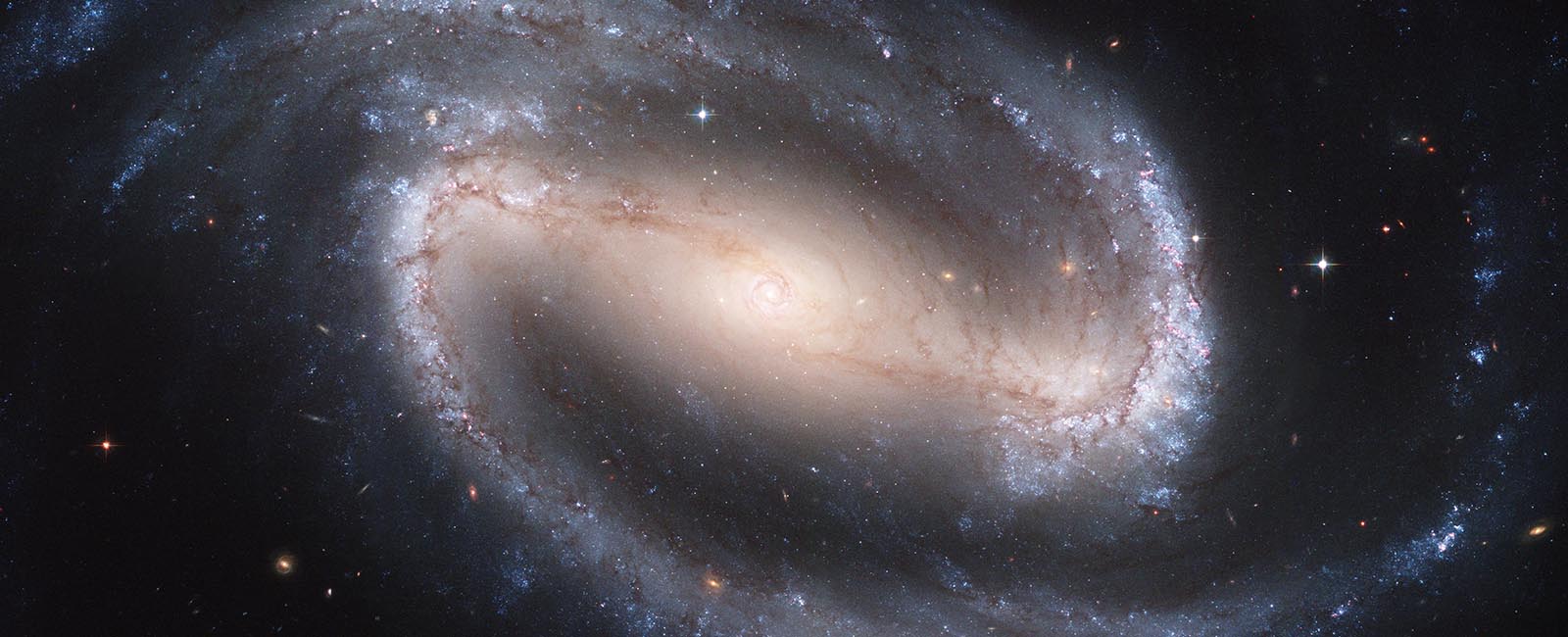
Galaxies are among the most important structures in the cosmos. They contain stars, gas, dust, planets, and dark matter held together by gravity. Galaxies can differ greatly in size, shape, and composition. NASA identifies major galaxy forms such as spiral, elliptical, and irregular galaxies. NASA Science Some galaxies contain enormous numbers of stars, while smaller dwarf galaxies may contain comparatively few.
Our home galaxy, the Milky Way, is a barred spiral galaxy with a disk extending more than 100,000 light-years. Earth and the Solar System are located within this vast stellar system. The Milky Way is itself part of a larger collection called the Local Group, which includes many other galaxies. On still larger scales, galaxies gather into groups, clusters, and other structures that form parts of the cosmic web. NASA Science
Stars: The Luminous Objects of Space
Stars are enormous spheres of extremely hot gas that produce energy through nuclear processes in their cores. Our Sun is an example of a star and provides most of the energy that supports life on Earth. Stars can vary significantly in mass, temperature, brightness, and lifetime.
Stars also play a major role in the development of the cosmos. Inside stars, nuclear fusion creates elements from simpler elements. When massive stars reach the end of their lives, some undergo powerful explosions that distribute heavier elements into surrounding space. Those materials can later become part of new stars, planets, and other celestial objects. In this way, stars participate in a long cosmic cycle of formation, evolution, and transformation.
Planets and Other Celestial Objects
The cosmos contains far more than stars and galaxies. Planets, moons, asteroids, comets, dwarf planets, nebulae, and other objects occupy space across countless planetary systems. Our Solar System includes eight recognized planets, numerous moons, dwarf planets, asteroids, comets, and smaller bodies.
Astronomers have also discovered thousands of planets beyond our Solar System, known as exoplanets. These discoveries have changed our understanding of planetary systems and raised important questions about how planets form and whether environments suitable for life might exist elsewhere. Studying these distant worlds is challenging because they are generally very far away and often cannot be seen directly in ordinary visible light.
Black Holes and Extreme Cosmic Environments
Black holes are among the most intriguing objects in the cosmos. They are regions of space where gravity is so strong that, beyond the event horizon, even light cannot escape. Black holes can form through the collapse of massive stars, while supermassive black holes are found at the centers of many large galaxies.
Although black holes themselves do not emit ordinary visible light from within their event horizons, astronomers can detect their influence on surrounding matter. Gas and dust falling toward a black hole can become extremely hot and produce powerful radiation. Scientists also study how black holes interact with stars, galaxies, and other objects to understand their role in cosmic evolution.
Dark Matter and Dark Energy
One of the greatest mysteries of the cosmos involves dark matter and dark energy. Ordinary matter, including stars, planets, gas, and living organisms, represents only a small portion of the total contents of the universe according to current cosmological models. NASA explains that roughly 27% is attributed to dark matter and about 68% to dark energy, while ordinary matter accounts for less than 5%.
Dark matter does not appear to interact with light in the same way as ordinary matter, but its gravitational effects can be observed. Scientists use these effects to explain the movements of galaxies and the structure of large cosmic systems. Dark energy is associated with the accelerating expansion of the universe, although its fundamental nature remains uncertain. Understanding both could significantly improve scientific knowledge of how the universe works.
How Scientists Study the Cosmos
Scientists cannot travel across the universe to examine distant objects directly, so they rely heavily on telescopes and other instruments. Different wavelengths of electromagnetic radiation reveal different information about celestial objects. Visible light can show stars and galaxies, while infrared, radio, ultraviolet, X-ray, and gamma-ray observations reveal phenomena that may be difficult or impossible to detect using visible light alone.
Large astronomical surveys can examine enormous regions of the sky and collect information about millions of galaxies. For example, the COSMOS astronomical survey studies galaxy formation and evolution by observing a particular region of the sky using multiple major observatories and wavelengths. The survey has detected more than two million galaxies and provides information covering a substantial portion of cosmic history.
The Cosmic Web and Large-Scale Structure
The cosmos has structure on many different scales. Individual stars form planetary systems, galaxies contain enormous collections of stars, and galaxies themselves gather into groups and clusters. On even larger scales, galaxies form interconnected patterns separated by vast cosmic voids.
Scientists often describe this arrangement as the cosmic web. Galaxy clusters, filaments, walls, and enormous empty regions create a complex pattern extending across immense distances. Gravity, dark matter, cosmic expansion, and the distribution of matter all influence how these structures develop. Studying large-scale structure helps researchers understand how small variations in the early universe eventually grew into the enormous systems observed today.
Why Studying the Cosmos Matters
Research into the cosmos is not simply about looking at distant stars. It helps scientists understand fundamental physical principles and the history of everything we can observe. By studying ancient light, distant galaxies, stars, and planetary systems, astronomers can investigate how the universe has changed over billions of years.
Cosmic research can also lead to technological developments. Space telescopes, sensitive detectors, imaging systems, computing methods, and data-processing techniques developed for astronomy can have applications beyond space science. More importantly, studying the universe encourages people to ask fundamental questions about matter, time, space, and existence itself.
The Future of Cosmic Exploration
The exploration of the cosmos is likely to continue expanding as telescopes and scientific instruments become more advanced. Researchers are working to observe increasingly distant galaxies, investigate exoplanets, study black holes, measure cosmic expansion, and understand the mysterious components of the universe.
Future observations may answer some long-standing questions while creating entirely new ones. Scientists still do not know the complete nature of dark matter or dark energy, and many details about the earliest moments of the universe remain uncertain. Continued observation, improved technology, and new theoretical models will help researchers refine their understanding.
Conclusion
The cosmos represents the vast entirety of space, time, matter, and energy and includes everything from our Solar System to distant galaxies and enormous cosmic structures. Modern astronomy has revealed an evolving universe filled with stars, planets, galaxies, black holes, and mysterious forms of matter and energy. Yet many fundamental questions remain unanswered. From studying ancient cosmic light to observing distant galaxies, scientists continue to expand human knowledge of the universe. The journey of understanding the cosmos is therefore far from complete. Each discovery provides another piece of a much larger picture and reminds us how much there is still to learn about the universe surrounding us.


